 English
  日本語
日本語  Deutsch
  Français
  Español
  Русский
  Português

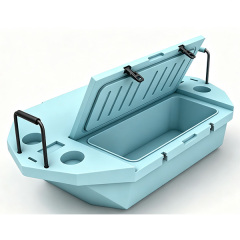
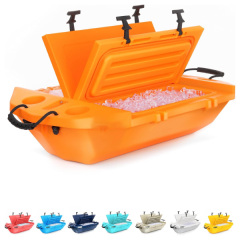
Rotomolded Floating Cooler: A Custom Case Study from Blow Molding to Rotomolding
Floating coolers have become a staple for kayak fishing, river tubing, beach days, and poolside gatherings. They keep drinks cold and stay afloat, so you don't have to paddle back to shore every time someone needs a refill.
Most floating coolers on the market today are blow-molded. Blow molding is cost-effective, but the walls are typically only 2–3 mm thick, the insulation layer is thin, and ice retention often maxes out at around 24 hours. Structural weak points at seams can also crack under impact.
Boright Industries recently developed a rotomolded floating cooler for an overseas outdoor brand. The goal was to keep the floating form factor while significantly improving ice retention, durability, and overall build quality. We replaced the blow-molded shell with a seamless rotomolded one-piece body and used in-house PU foam for insulation.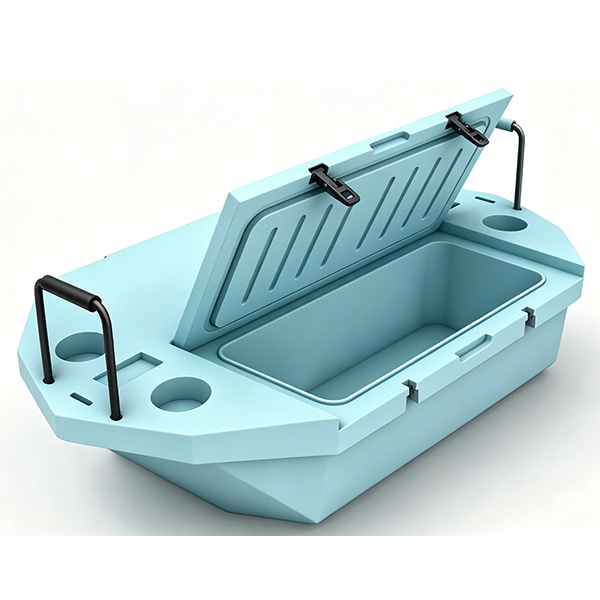
1. Why Rotomolding Beats Blow Molding for Floating Coolers
Rotational molding and blow molding are fundamentally different processes, and the performance gap shows up in the product itself.
| Spec | Blow-Molded Cooler | Rotomolded Cooler (Boright) |
|---|---|---|
| Construction | Two-piece shell, seams present | One-piece seamless shell |
| Wall thickness | ~2–3 mm | 5–8 mm, uniform |
| Insulation | Thin, uneven foam | High-density PU foam, uniform fill |
| Ice retention | ~1–3 days | 2–3+ days (full ice load) |
| Impact resistance | Seams are weak points; prone to cracking | Seamless, impact-resistant, drop-tested |
| Hardware mounting | Self-tapping screws into thin walls | Molded-in inserts / thick-wall mounting |
| Flotation | Relies on hollow cavity; can sink if cracked | PU foam core provides reliable flotation even if shell is damaged |
For a floating cooler, ice retention and structural integrity are the two metrics that matter most. Rotomolding eliminates seams—the natural weak point of blow-molded shells—and allows for a thicker insulation layer. Boright's in-house high-pressure PU foaming line injects rigid polyurethane foam into the rotomolded shell, achieving 2–3 days of ice retention under a full ice load. That's a meaningful improvement over typical blow-molded performance at the same capacity and ambient temperature.
We use food-grade LLDPE for the outer shell. It's UV-resistant, corrosion-resistant, and impact-resistant—well-suited for long-term exposure to water and outdoor environments. That material choice also makes the cooler more durable when towed behind a kayak or dragged across sand.
Want to explore rotomolding for your own product? See our custom rotomolding & mold services for full capabilities.
2. Key Design Features of This Custom Floating Cooler
The client provided reference images and a 3D file. The brief: match the look and layout of the reference product, but switch to a rotomolded one-piece construction and solve several functional issues.
1. Latch System: From Thin Rod to Heavy-Duty Cam Latch
The reference product used thin rod-style plastic latches. Stress concentrates on a small rod, which can deform over time, and sealing pressure is uneven. We switched to KEPT-style heavy-duty cam latches. The latch body and base are hinged, applying even downward pressure across the lid gasket when closed. Nylon + silicone construction resists UV and corrosion. Mounting was also changed from screws to molded-in inserts to avoid drilling into thin-wall areas.
2. Handle: From Rope to Recessed Grip
The reference used a soft rope threaded through side holes. Rope tangles in water, and the holes create stress points. We designed recessed grip pockets molded directly into both sides of the body, paired with a foldable nylon handle. The pocket is formed in the mold without compromising the shell's watertight integrity. Users can grab and lift naturally, with no rope to snag.
3. Bottom: Integrated Wheel Mounts
The client wanted optional wheel kits for rolling across sand and hard surfaces. We added molded-in wheel mounting pads on the bottom with embedded metal inserts. This maintains mounting strength without drilling through the hull—preserving watertightness. The wheel kit itself is quick-detach, so users can configure the cooler for different terrains.
4. Interior: Smooth-Release Geometry
Demolding is a core challenge in rotomolding. Sharp interior corners can cause surface tearing during release. We smoothed the interior edges based on the 3D file, replacing right angles with generous radii and optimizing the mold parting line. This small change has a direct impact on production yield—smoother release means more consistent surface quality.
5. Lid Construction
The lid uses a dual-wall rotomolded structure with PU insulation foam injected between the walls. The gasket groove is molded directly into the lid, so the seal simply presses into place—no adhesives required. The dual-side opening design lets users access contents from either side while maintaining balance on the water. Cup holder recesses on top are also formed in the mold.
This product fits into our rotomolded hard coolers line, and its components fall under cooler parts & accessories.
3. Real-World Performance on the Water
Floating coolers are used in kayak fishing, river tubing, beach camping, and pool parties. Here's how this custom build performs in those scenarios:
- Flotation: The PU foam core provides reliable buoyancy. Even if the outer shell is punctured, the closed-cell foam does not rapidly absorb water, so the cooler stays afloat.
- Towing stability: A hydrodynamic hull profile (inspired by the reference product's Flow Tow design) reduces drag and keeps the cooler stable while being towed—no flipping or spinning.
- Ice retention: With a full ice load at ~32°C (90°F) ambient, internal temperatures stay between 0–10°C (32–50°F) for roughly 96 hours (4 days). For day trips or weekend outings, ice loss is far lower than with blow-molded alternatives.
- Weather resistance: LLDPE resists UV degradation, so long sun exposure won't make it brittle. It's also unaffected by saltwater or freshwater.
If you have a similar floating cooler or insulated fish tub project, explore our insulated fish tubs / coolers or contact us to discuss specifications.
4. About Boright Industries: Your Rotomolding & OEM Partner
Boright Industries is a dedicated rotomolding manufacturer based in Ningbo, China, with over 10 years of experience. We specialize in rotomolded coolers, insulated containers, tool boxes, and custom rotomolded products—from design through mass production.
Production capacity:
- 3 shuttle-type dual-station rotomolding machines + 1 high-pressure PU foaming machine
- Annual capacity up to 150,000 cooler boxes
- In-house PU rigid foam line for consistent density and insulation performance
- Molds primarily in forged aluminum 6061 (high precision, excellent surface finish); cast aluminum A356 available for different shapes and budgets
- 5,000 m² facility; daily output of 3,000+ standard units
Design & engineering:
- Lead designer with 10+ years in rotomolded product structure—deep experience in load-bearing, sealing, and assembly details
- Full-service from requirements analysis, 3D modeling, and mold making to mass production
- OEM/ODM support: colors, logos, packaging, hardware, and accessories
- Low MOQ (from 50 units); rapid prototyping in 3–5 days
Markets served: USA, Japan, South Korea, Australia, New Zealand, Canada, and other developed markets.
Whether you need rotomolded coolers, tool boxes, or a fully custom rotomolded product, start with our custom rotomolding service or browse the rotomolded tool box line for reference.
5. How to Work With Boright Industries
Product development flow: Discovery → 3D Design & Approval → Mold Making → Sampling → Mass Production
Explore our product lines:
- Rotomolded Hard Coolers
- Custom Rotomolding & Molds
- Rotomolded Tool Boxes
- Insulated Fish Tubs
- Cooler Parts & Accessories
Website: boright.cn
Product Development | Mass Production | In-house Mold Making