Rotomolded vs. Injection‑Molded vs. Soft‑Sided:
A Manufacturer's Comparison
By Fred – Senior Foreign Trade Manager, Boright Industries (10+ years in rotomolding)
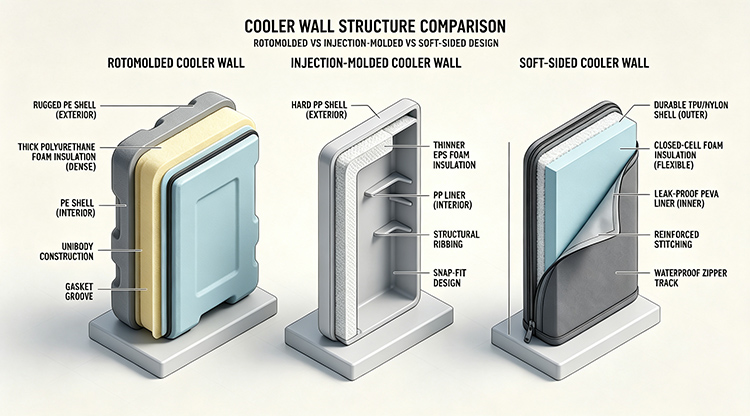
Three construction methods – one clear winner for professional use
As a manufacturer with over a decade of hands‑on experience in rotomolding, I'm often asked: “Which type of cooler should I choose – rotomolded, injection‑molded, or soft‑sided?” The honest answer depends on your needs, but if you demand durability, long‑term ice retention, and reliability in harsh conditions, rotomolding is the undisputed leader.
This isn't a marketing slogan – it's engineering reality. In this article, I'll break down the three construction methods from a manufacturer's perspective, comparing materials, insulation, hardware, and real‑world performance. By the end, you'll understand exactly why rotomolded coolers are the preferred choice for professionals – and why Boright Industries is the partner you can trust for premium rotomolded products.
The Three Construction Methods
1. Rotomolding – The Professional Standard
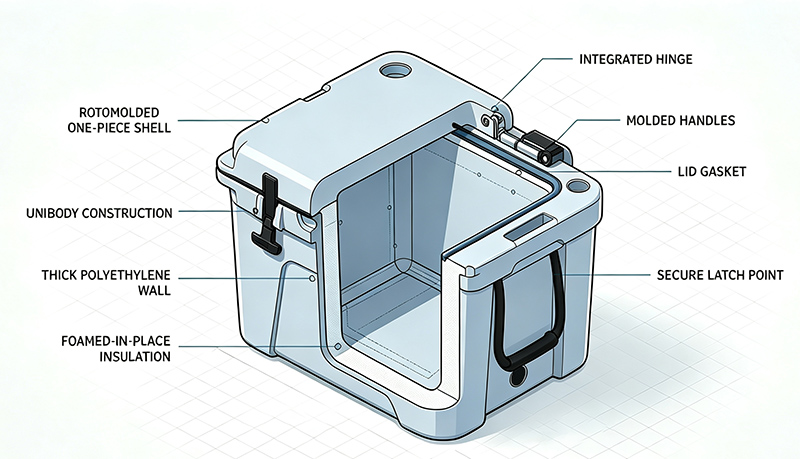
Rotomolding: seamless, stress‑free, and built for performance
How it works: LLDPE powder is placed in a mold that rotates biaxially while heated. The plastic melts and coats the entire interior evenly, forming a single‑piece, seamless shell. After cooling, the hollow cavity is injected with high‑density polyurethane foam under pressure.
Why it wins: No seams means no weak points – impact energy dissipates across the entire shell. Wall thickness (5–8 cm) allows maximum insulation, and the foam bonds to both inner and outer walls, creating a rigid composite that blocks heat transfer and enhances structural strength. This is why rotomolded coolers can keep ice for 5–7 days and survive drops, truck beds, and even bear attacks (IGBC certified models).
Trade‑off: Rotomolding is slower and more expensive per unit – but the longevity (10–15 years) and performance justify the investment for serious users.
2. Injection Molding – The Cost‑Effective Generalist
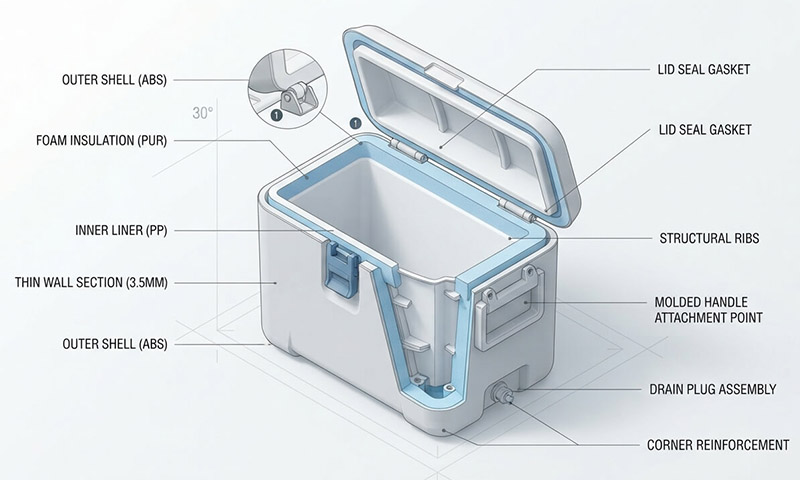
Injection molding: fast production, but at the cost of strength and insulation
Image from the internet, if infringing please contact us to remove.
How it works: Molten plastic (usually PP or HDPE) is injected into a mold under high pressure, cooled, and ejected. The inner and outer shells are made separately and then assembled with a foam core (or just air in cheap versions).
The downsides: The assembly process creates joints and seams – these are stress concentrators and thermal bridges. Wall thickness is limited (2–3 cm), and foam often doesn't fill every corner, leaving gaps. Ice retention is typically 24–48 hours, and the cooler is more susceptible to cracking at the hinges and corners over time.
When it makes sense: For weekend picnics, short trips, and budget‑conscious buyers – it's a decent product for light use. But for professional or demanding applications, it falls short.
3. Soft‑Sided – Lightweight but Limited
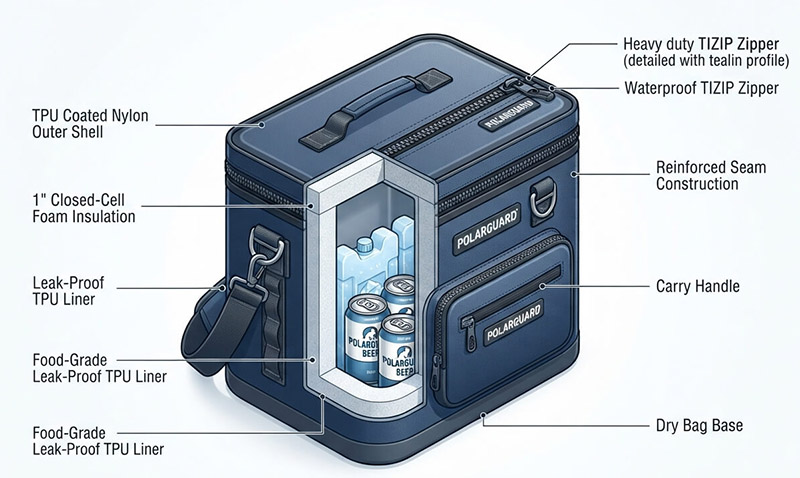
Soft‑sided: portable, but thin insulation and fragile
Image from the internet, if infringing please contact us to remove.
How it works: Outer fabric (nylon/polyester), a thin layer of foam or batting (1–2 cm), and a waterproof liner. Seams are stitched or RF‑welded.
Limitations: Minimal insulation – ice melts in 6–12 hours. The fabric is prone to punctures, and the zippers or closures often fail. While convenient for carrying, it offers no protection against impacts or crushing. For daily commuting or short errands it's fine, but it's not a serious cooler for any multi‑day use.
Head‑to‑Head Comparison
| Performance Factor |
Rotomolded (LLDPE) |
Injection‑Molded |
Soft‑Sided |
| Shell Integrity |
Seamless, one‑piece |
Assembled with joints |
Fabric, no rigid shell |
| Insulation Thickness |
5–8 cm PU foam |
2–3 cm EPS/PU |
1–2 cm batting |
| Ice Retention (25°C) |
5–7 days |
1–2 days |
6–12 hours |
| Impact & Crush Resistance |
★★★★★ (supports adult weight) |
★★★ (prone to cracks) |
★ (punctures easily) |
| Service Life |
10–15 years |
3–5 years |
1–3 years |
| Typical Weight (50L) |
12–18 kg |
6–10 kg |
1.5–4 kg |
| Price Range |
Higher ($200+) |
Mid ($50–150) |
Low ($20–80) |
Material Matters – LLDPE vs. HDPE & Foam Quality
Rotomolded coolers use LLDPE – Linear Low‑Density Polyethylene. Its molecular structure provides exceptional environmental stress crack resistance and low‑temperature toughness, which is why it doesn't become brittle in freezing conditions. The foam is high‑pressure injected polyurethane that fills every void and bonds to the shell, creating a monolithic structure.
In contrast, injection‑molded coolers often use HDPE or PP, which are more rigid but more susceptible to cracking over time, especially at assembly joints. Their foam is usually cut‑to‑size EPS or PU panels – gaps are inevitable, creating thermal bridges that reduce overall efficiency.
Food safety: All Boright rotomolded products use FDA‑approved food‑grade LLDPE, ensuring safe contact with food and ice.
Hardware – The Silent Decider of Longevity
Hardware is where many coolers fail prematurely. Here's how the three constructions compare:
- Gasket: Rotomolded coolers feature thick silicone or TPE gaskets in a grooved channel, providing an airtight seal. Injection‑molded units often have thinner gaskets or none at all. Soft‑sided coolers rely on zippers, which are rarely fully airtight.
- Hinges: Rotomolded integrates stainless steel pins or molded‑in hinges that are virtually unbreakable. Injection‑molded uses plastic snap hinges that become brittle in cold weather.
- Latches: Rubber T‑latches (common in rotomolded) provide constant compression and never snap. Plastic latches on injection‑molded break easily.
- Drain plug: Rotomolded designs use deep threads with O‑rings; injection‑molded plugs often have shallow threads prone to cross‑threading.
These details may seem minor, but they determine whether your cooler lasts a decade or just a few seasons.
Why Rotomolding Wins – A Manufacturer's Perspective
From our experience serving clients in fishing, outdoor, and industrial sectors, the choice is clear:
- Durability: Rotomolded coolers survive drops, heavy loads, and rough transport – no cracks, no leaks.
- Insulation: The combination of thick LLDPE walls and full‑cavity PU foam gives unmatched ice retention – essential for multi‑day trips.
- Lifespan: A rotomolded cooler is a long‑term investment – 10+ years of reliable service vs. replacing injection‑molded every few years.
- Bear‑resistance: Many rotomolded models are IGBC certified, a requirement for use in certain wilderness areas.
For brands and enterprises, rotomolding also offers design flexibility – we can integrate logos, custom colours, and unique features directly into the mold, giving your product a distinctive identity.
Boright Industries – Your Trusted Rotomolding Partner
With over 10 years of dedicated rotomolding experience, Boright Industries is more than a factory – we are a solution provider. Our capabilities include:
- Production capacity: 3 shuttle‑type twin‑station rotomolding machines + 1 high‑pressure PU foaming machine – annual output of 150,000 coolers.
- In‑house mold making: We design and manufacture molds using forged aluminium 6061 (high precision) or cast A356 (cost‑effective), giving you full control over quality and timeline.
- Expert design team: Led by engineers with 10+ years in rotomolding, we optimise structure, sealing, and assembly for performance and manufacturability.
- Global compliance: Our products meet FDA, REACH, and other international standards, exported to the US, Japan, South Korea, Australia, New Zealand, Canada, and more.
Whether you need a standard rotomolded cooler or a fully custom design, we have the expertise and capacity to bring your product to life.
Our Rotomolded Product Range
Request a Custom Quote → View Products
Fred – Senior Foreign Trade Manager With over 10 years in the rotomolding industry, Fred has worked with clients worldwide, helping them design, develop, and manufacture premium rotomolded products. His expertise spans material selection, structural design, and supply chain optimisation – ensuring every project meets the highest standards of quality and performance.
Frequently Asked Questions
Why is rotomolding better for professional coolers?
Rotomolding produces a seamless, stress‑free shell with uniform thick walls, allowing high‑density PU foam injection for superior insulation and impact resistance. It outperforms injection‑molded (with assembly joints) and soft‑sided (thin insulation) in durability and ice retention.
What material does Boright use for rotomolded coolers?
We use FDA‑approved food‑grade LLDPE (Linear Low‑Density Polyethylene), which offers excellent low‑temperature toughness and environmental stress crack resistance – ideal for rotomolding.
Can Boright customize rotomolded products for my brand?
Absolutely. We provide full in‑house mold making (forged aluminium 6061 or cast A356), structural design, color and logo customization, and mass production – helping you launch your own rotomolded line quickly.
 English
 日本語
日本語
 Deutsch
 Français
 Español
 Русский
 Português
繁體中文
Italiano
한국어
ไทย
Tiếng Việt
Bahasa Melayu
Polskie
Shqiptare
عربي
Azərbaycan
Gaeilge
Eesti keel
Euskara
беларуская
български
íslenskur
Bosanski
فارسی
Afrikaans
Dansk
Filipino
Suomalainen
ខ្មែរ
ქართული
ગુજરાતી
қазақ
Kreyòl ayisyen
Hausa
Nederlands
Galego
Català
čeština
ಕನ್ನಡ
Hrvatski
Latinus
Latviski
ພາສາລາວ
Lietuvių
Română
Malagasy
Malti
मराठी
മലയാളം
македонски
Maori
Монгол
বাংলা
Hmoob
Zulu
नेपाली
Norsk
ਪੰਜਾਬੀ
Chichewa
Svenska
Српски
Sesotho
සිංහල
Esperanto
Slovenský
Slovenščina
Kiswahili
Türk
اردو
Hայերեն
Igbo
יידיש
नहीं।
Basa Sunda
Basa Jawa
Yoruba
አማርኛ
ଓଡିଆ
Татар
Frysk
Кыргызча
Corsu
Kurdî
Lëtzebuergesch
Kinyarwanda
IsiXhosa saseMzantsi Afrika
پښتو
Samoa
Gàidhlig na h-Alba
Türkmenler
ئۇيغۇرچە
Ōlelo Hawaiʻi
Kiniki
Shona
Bahasa Indonesia
Save
Português
繁體中文
Italiano
한국어
ไทย
Tiếng Việt
Bahasa Melayu
Polskie
Shqiptare
عربي
Azərbaycan
Gaeilge
Eesti keel
Euskara
беларуская
български
íslenskur
Bosanski
فارسی
Afrikaans
Dansk
Filipino
Suomalainen
ខ្មែរ
ქართული
ગુજરાતી
қазақ
Kreyòl ayisyen
Hausa
Nederlands
Galego
Català
čeština
ಕನ್ನಡ
Hrvatski
Latinus
Latviski
ພາສາລາວ
Lietuvių
Română
Malagasy
Malti
मराठी
മലയാളം
македонски
Maori
Монгол
বাংলা
Hmoob
Zulu
नेपाली
Norsk
ਪੰਜਾਬੀ
Chichewa
Svenska
Српски
Sesotho
සිංහල
Esperanto
Slovenský
Slovenščina
Kiswahili
Türk
اردو
Hայերեն
Igbo
יידיש
नहीं।
Basa Sunda
Basa Jawa
Yoruba
አማርኛ
ଓଡିଆ
Татар
Frysk
Кыргызча
Corsu
Kurdî
Lëtzebuergesch
Kinyarwanda
IsiXhosa saseMzantsi Afrika
پښتو
Samoa
Gàidhlig na h-Alba
Türkmenler
ئۇيغۇرچە
Ōlelo Hawaiʻi
Kiniki
Shona
Bahasa Indonesia
Save English
  日本語
日本語  Deutsch
  Français
  Español
  Русский
  Português